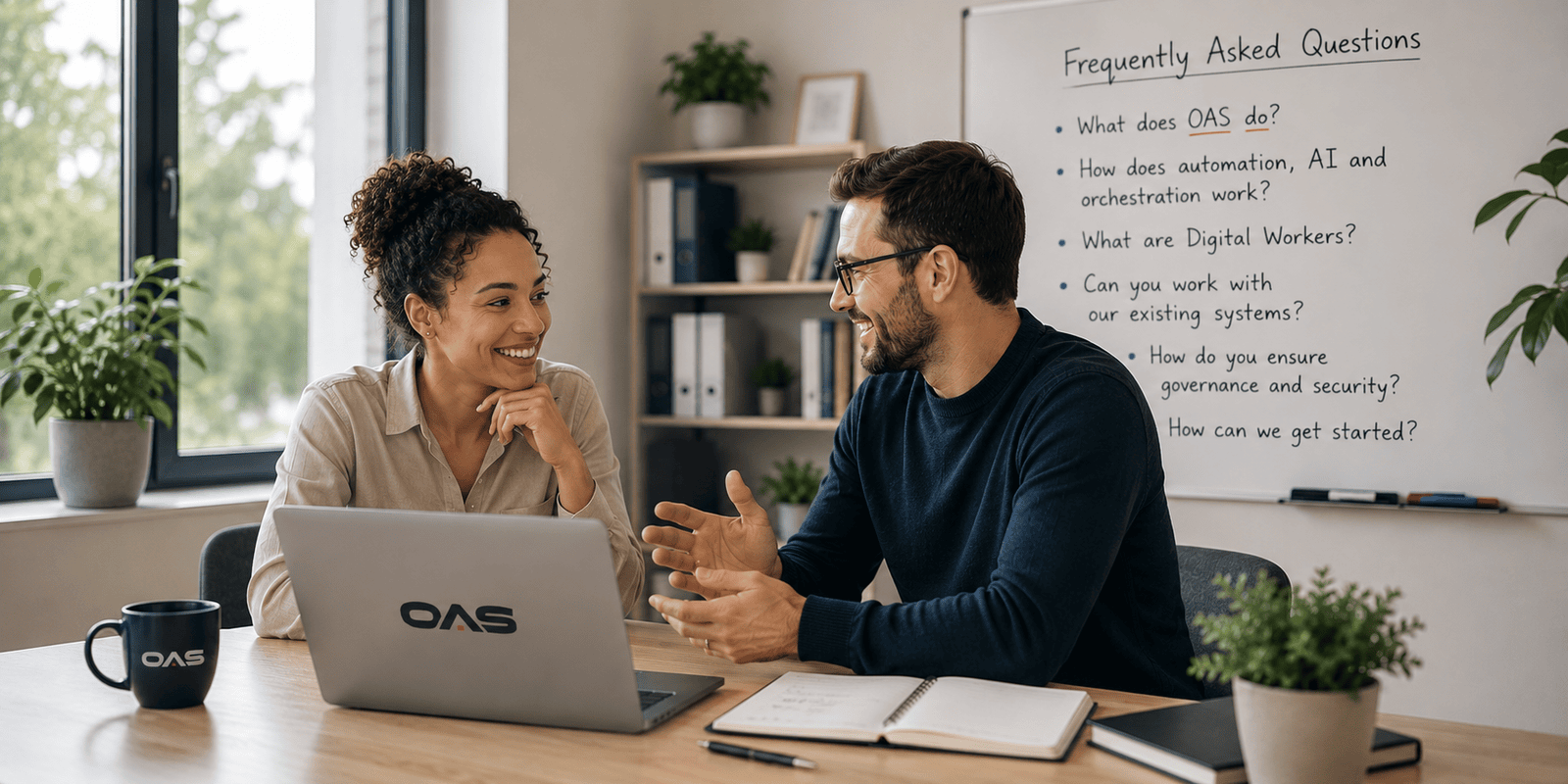
Clear answers to common questions about OAS and our services.
Clear answers to common questions about OAS and our services.
Getting Started
OAS helps organisations connect and improve operations through automation, AI and orchestration. We bring systems, workflows, data and people together to reduce manual effort, improve efficiency and create more connected end-to-end processes.
We help address operational challenges such as disconnected systems, fragmented workflows, manual administration, repetitive activity, inconsistent hand-offs and information spread across multiple teams or systems.
No. You can come to us with an operational problem rather than a predefined solution. We can work with you to understand the process, identify where the pressure or inefficiency exists and determine where orchestration, AI and automation could add value.
How it Works
Automation handles repeatable operational work and standardises processes. AI can support activities such as analysis, classification and insight. Orchestration coordinates systems, workflows, people and Digital Workers so that the different parts of a process operate together from end to end.
Digital Workers perform repeatable operational activities that would otherwise require manual effort. They can work alongside people, AI and existing systems as part of an orchestrated process.
Individual automations can form part of the solution, but our wider approach is about connecting the operation. Orchestration allows workflows, systems, data, Digital Workers, AI and people to work together rather than operating as isolated components.
Technology, Governance and Deployment
Not necessarily. In many cases, orchestration and automation can work across existing systems and create a connected operational layer around them. Any requirement for technology changes would depend on the specific environment and use case.
OAS works with automation, AI and orchestration technologies to create connected operational solutions. OAS is also an SS&C Blue Prism partner, with Blue Prism technology forming an important part of our automation capability.
Not where professional judgement, accountability or human approval is required. AI can support people by analysing information, assisting with repetitive work and surfacing relevant information, while human involvement can be retained at the appropriate decision and approval points.
Governance and risk controls are considered as part of the solution design rather than added afterwards. The OAS operating model can combine automation and AI with controlled workflows, human involvement, monitoring and appropriate governance.